Quick Summary
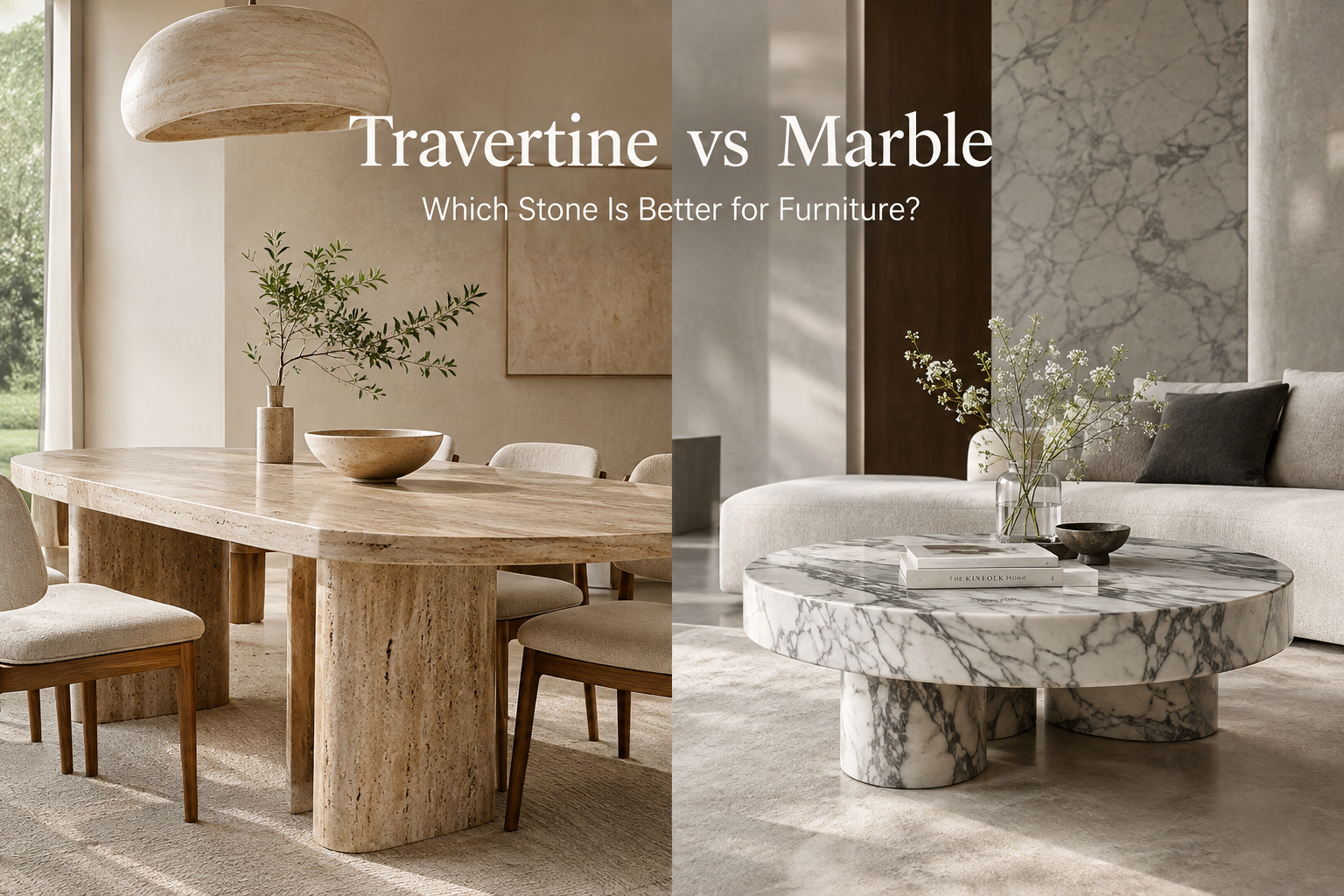
When selecting natural stone furniture for a residential, hospitality, or commercial project, travertine and marble are two of the most popular materials to consider.
Both materials can be used to create custom dining tables, coffee tables, console tables, and other stone furniture, but they create very different visual effects.
Travertine is known for its warm tones, natural texture, and architectural character. Marble is widely recognized for its distinctive veining, wide color range, and luxury appearance.
If you are deciding between travertine and marble for a custom furniture project, this guide explains the main differences in appearance, durability, maintenance, finishes, and customization.
Travertine vs Marble Appearance
The visual difference between travertine and marble is one of the most important considerations when selecting a material for furniture.
Travertine
Travertine is generally recognized for its warm neutral colors, natural pores, layered appearance, and subtle movement.
Common travertine colors include:
Beige
Cream
Ivory
Warm brown
Light gray
Travertine works particularly well when the interior concept emphasizes natural materials, soft colors, and architectural simplicity.
For furniture, travertine can create a strong material presence without relying on dramatic patterns.
Marble
Marble offers a broader range of colors and natural patterns.
Depending on the stone variety, marble may feature:
White backgrounds
Gray veining
Green tones
Black backgrounds
Purple or burgundy veining
Beige and warm neutral colors
Marble is often selected when the stone itself is intended to become a major visual feature of the furniture.
For large dining tables, coffee tables, and console tables, natural marble veining can become an important part of the overall design.
Travertine vs Marble for Dining Tables
Both materials can be used to create custom dining tables, but the final appearance can be very different.
Travertine Dining Tables
Travertine dining tables generally create a warm and natural atmosphere.
They can work particularly well with:
Natural wood
Neutral fabrics
Soft lighting
Minimalist interiors
Contemporary residential spaces
Hospitality interiors
A travertine dining table is often suitable for projects where the goal is to create an understated but sophisticated material palette.
Marble Dining Tables
Marble dining tables can create a stronger visual statement.
Large natural slabs allow the veining and color movement of the stone to become part of the furniture design.
Marble dining tables can be suitable for:
Luxury residences
Boutique hotels
Restaurants
High-end hospitality projects
Contemporary interiors
Statement dining spaces
For custom marble dining tables, selecting the right slab is particularly important because the final appearance depends heavily on the natural pattern of the selected stone.
Explore our custom stone tables for examples of natural stone furniture.
Travertine vs Marble for Coffee Tables
Coffee tables are another popular application for both travertine and marble.
Travertine Coffee Tables
Travertine is often used for low-profile coffee tables with simple geometric forms.
Rounded edges, monolithic bases, and natural stone surfaces can create a soft architectural appearance.
Travertine coffee tables can work well in:
Contemporary living rooms
Minimalist interiors
Natural material palettes
Luxury residential spaces
Marble Coffee Tables
Marble coffee tables can place greater emphasis on natural veining and color.
Depending on the stone and design, marble can be used to create:
Statement tabletops
Geometric designs
Sculptural furniture
Waterjet-cut patterns
Custom decorative details
The shape of the furniture should be considered together with the natural pattern of the marble slab.
Travertine vs Marble Durability and Maintenance
Both travertine and marble are natural stones that can provide long-term performance when properly fabricated, finished, installed, and maintained.
However, their physical characteristics are different.
Travertine
Travertine has a naturally porous structure.
Depending on the selected stone and finish, it may require:
Proper sealing
Routine cleaning
Periodic inspection
Appropriate surface care
Filled travertine can provide a smoother furniture surface while retaining the characteristic appearance of the stone.
Marble
Marble is generally denser than travertine, but it can still be affected by acidic substances and surface etching.
Recommended care includes:
Appropriate sealing
pH-neutral cleaning products
Prompt removal of acidic substances
Avoiding abrasive cleaning methods
For both materials, maintenance requirements depend on the exact stone, surface finish, furniture application, and environment.
Travertine vs Marble Surface Finishes
The same natural stone can look significantly different depending on its surface finish.
Common finishes for stone furniture include:
Polished
Honed
Natural
Brushed
Custom finishes
Polished Finish
A polished finish creates a smoother and more reflective appearance.
It can emphasize:
Marble veining
Stone color
Surface depth
Decorative details
Polished finishes are often considered for luxury furniture and statement interiors.
Honed Finish
A honed finish provides a softer and less reflective appearance.
It can work particularly well for:
Minimalist interiors
Contemporary furniture
Natural material palettes
Understated stone designs
Natural and Textured Finishes
Natural or textured finishes can emphasize the character of the stone itself.
This approach can be particularly effective when the design intentionally highlights the natural texture and variation of travertine.
The finish should therefore be selected together with the stone and the overall furniture design.
Travertine vs Marble for Custom Stone Furniture
For custom stone furniture, both travertine and marble offer a wide range of customization possibilities.
Custom Dimensions
Furniture can be produced according to project-specific dimensions.
This is particularly useful for:
Residential projects
Villas
Hotels
Restaurants
Property developments
Interior design projects
Custom Shapes
Natural stone can be fabricated into different geometric and organic forms.
Examples include:
Round tops
Oval tops
Racetrack shapes
Rectangular designs
Irregular organic forms
Sculptural bases
Custom Edge Profiles
Edge treatment can also change the appearance of a stone table.
Depending on the design, edges may be:
Straight
Rounded
Beveled
Sculpted
Custom profiled
Metal Inlays and Decorative Details
Stone furniture can also combine natural stone with other materials.
Common decorative details include:
Brass
Copper
Stainless steel
Custom metal components
These details can be used to create more distinctive furniture designs for residential and hospitality projects.
Which Material Is Better for Your Furniture Project?
Neither travertine nor marble is universally better.
The appropriate material depends on the visual direction, furniture design, intended application, and project requirements.
Choose travertine if you want:
Warm neutral tones
Natural texture
Organic visual movement
A calm architectural appearance
Minimalist furniture
Contemporary residential interiors
Choose marble if you want:
Strong natural veining
Greater visual contrast
A dramatic stone appearance
Statement furniture
Luxury residential interiors
Hospitality furniture with distinctive stone patterns
The actual stone slab should also be considered before making a final decision because natural stone varies in color, pattern, texture, and movement.
How to Choose the Right Stone for Custom Furniture
Material selection should begin with the design concept rather than the stone name alone.
Consider the following factors:
1. Interior Design Style
Determine whether the project requires a warm and natural appearance or a more dramatic decorative stone.
2. Stone Pattern
Consider how the natural pattern will interact with the shape and size of the furniture.
Large surfaces can make veining and natural movement more visible.
3. Furniture Dimensions
The size and proportions of the furniture should be considered together with the available stone slab.
4. Surface Finish
Polished, honed, natural, or custom finishes can produce significantly different visual results.
5. Project Requirements
For commercial and residential projects, also consider:
Quantity
Custom fabrication
Packaging
Shipping
Installation requirements
Production schedule
For larger projects, these requirements should be discussed before final material selection and production.
OEM and ODM Custom Stone Furniture
Natural stone furniture can be developed as an OEM or ODM product for interior brands, designers, developers, hospitality groups, and project buyers.
A custom furniture project may involve:
Design drawings or references
Material selection
Stone slab selection
Custom dimensions
Prototype or sample development
Stone cutting and fabrication
Surface finishing
Quality inspection
Export packaging
International shipment
WIN WIN STONE works with specialized stone manufacturing resources in Guangdong, China, supporting custom stone furniture projects according to material, dimensions, finish, and design requirements.
Learn more about our OEM & ODM stone furniture capabilities.
Travertine vs Marble: Which One Should You Choose?
The right material depends on the requirements of your furniture project.
Travertine is often a strong choice for warm, natural, minimalist, and architectural furniture designs.
Marble can be suitable when distinctive veining, color variation, and stronger visual impact are central to the design.
For custom stone furniture, the final decision should consider:
Design direction
Stone appearance
Furniture dimensions
Surface finish
Intended application
Custom fabrication requirements
Project quantity and schedule
Instead of selecting a material only from a catalog image, it is better to evaluate the actual stone slab, finish, and furniture design together.
Final Thoughts
Travertine and marble can both create high-quality custom stone furniture, but they communicate different design characteristics.
Travertine brings warmth, natural texture, and architectural simplicity.
Marble offers distinctive veining, broader color possibilities, and stronger visual expression.
The best material depends on the project's design concept and technical requirements rather than a universal preference for one stone over another.
If you are developing a custom dining table, coffee table, console, or other stone furniture, contact WIN WIN STONE to discuss your material, design, and project requirements.
Frequently Asked Questions
Is travertine or marble better for furniture?
Neither material is universally better. Travertine is often selected for warm, natural, and architectural furniture designs, while marble is commonly chosen for distinctive veining, stronger visual contrast, and statement furniture.
Is travertine good for dining tables?
Yes. Travertine is widely used for custom dining tables and coffee tables, especially in warm, minimalist, and contemporary interiors.
Is marble good for custom furniture?
Yes. Marble is suitable for custom dining tables, coffee tables, console tables, and other furniture where natural veining and stone color are important design elements.
Does travertine require more maintenance than marble?
Both materials require appropriate care and sealing. Travertine has a more porous structure, while marble can be sensitive to acidic substances and etching. The appropriate maintenance depends on the stone, finish, and application.
Can travertine and marble furniture be customized?
Yes. Both materials can be customized in dimensions, shapes, edge profiles, surface finishes, and decorative details according to project requirements.
Can I order custom stone furniture for a hotel or residential project?
Yes. Custom stone furniture can be developed for residential, hospitality, restaurant, and other interior projects. Dimensions, quantities, materials, finishes, packaging, and delivery requirements can be discussed before production.
Explore More Solutions
Explore related stone collections, materials and custom project solutions.